
How a crypto-backed loan works
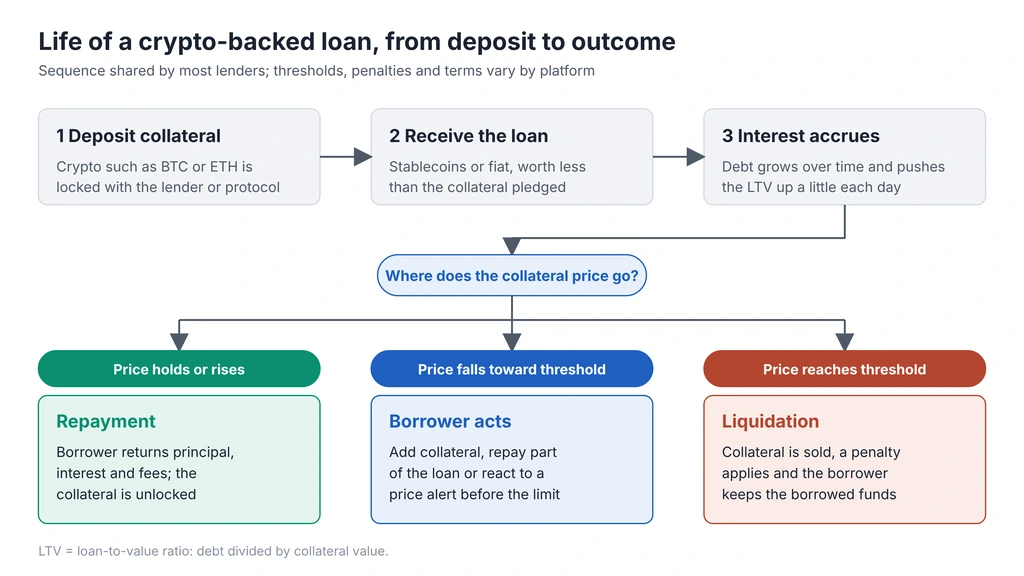
Borrowers who take a crypto-backed loan lock digital assets as collateral, receive a smaller amount in stablecoins or fiat currency, pay interest for as long as the debt stays open, and recover the collateral after full repayment. When the collateral price falls far enough, the lender or protocol sells part or all of the pledged assets to cover the outstanding debt, a process called liquidation.
Every other element of the product, from interest models to tax treatment, follows from the sequence of pledge, loan, repayment and forced sale.
Why people borrow instead of selling
Holders who expect Bitcoin to appreciate over several years often prefer a loan against crypto to a sale: a loan keeps market exposure in place and releases cash. A sale closes the position and forces the holder to buy back at an unknown future price.
Tax timing influences the decision in many countries, where a sale of crypto counts as a taxable event and a loan does not; some authorities treat certain DeFi transactions as disposals, and borrowers should check local rules or consult a tax advisor before relying on the distinction.
Speed adds a practical advantage: a DeFi loan settles within minutes and requires no credit check, and a bank loan takes longer and depends on an underwriting process.
Some borrowers use the proceeds for leverage and buy additional crypto with the borrowed funds. Leverage multiplies gains and losses in equal measure and accounts for the most common route to liquidation.
A worked example: $1,500 borrowed against 1 ETH
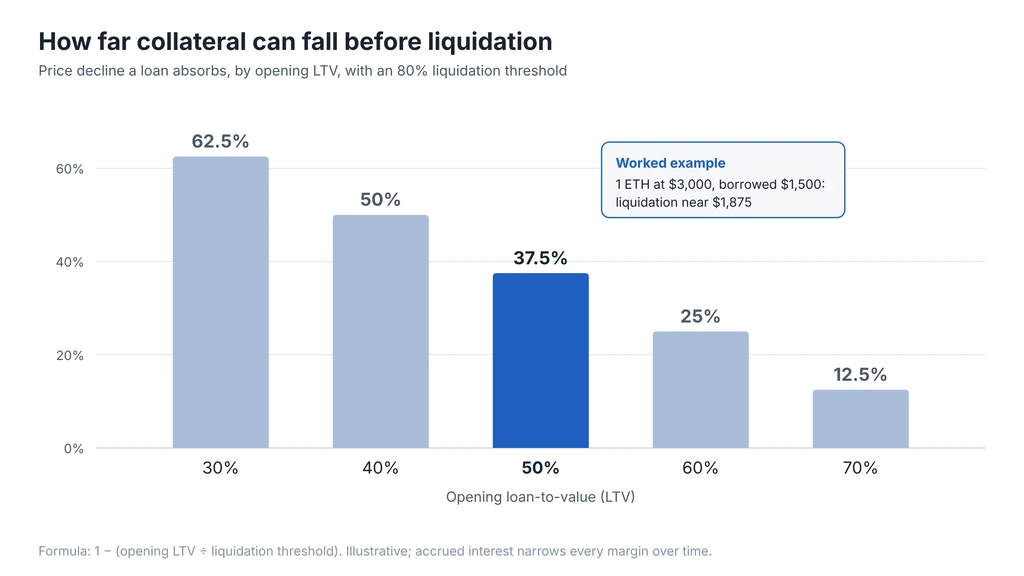
A borrower named Maria deposits 1 ETH valued at $3,000 and borrows $1,500 in USDC, which gives her a loan-to-value (LTV) ratio of 50%, calculated as $1,500 divided by $3,000. The platform sets its liquidation threshold for ETH at 80%.
At an ETH price of $2,500 her LTV reaches 60%, a level requiring no action yet and marking the point to begin monitoring the position. At $2,000 the LTV stands at 75%, close enough to the threshold to justify adding collateral or repaying part of the loan. At $1,875 the LTV hits 80% and liquidation can begin.
In practice interest adds to the debt and raises the LTV slightly every day. A fall of 37.5% in the ETH price from the opening level brings Maria to the threshold, a decline crypto markets have recorded within weeks on many occasions, which explains why experienced borrowers open loans well below the maximum LTV a platform allows.
What liquidation actually costs
On most DeFi protocols, an outside liquidation bot repays part of the borrower’s debt and receives the borrower’s collateral at a discount, commonly called a liquidation bonus or liquidation penalty. The borrower keeps the borrowed funds and gives up more collateral value than the debt it covered.
Design differs by protocol: some liquidate a position in steps and others close the whole loan at once. Aave’s documentation describes permissionless liquidations, which any network participant can start once a position’s health factor falls below 1, with a liquidator repaying up to 50% of the debt in most cases and up to 100% when the health factor reaches 0.95 or lower.
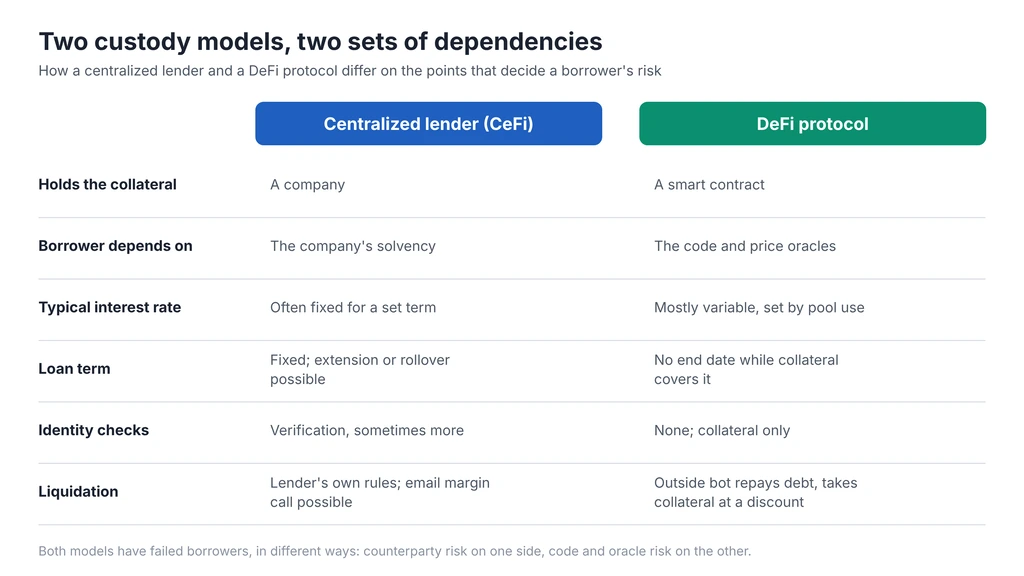
Centralized lenders set their own rules, which can include a margin call by email before the lender sells any collateral. Borrowers should read the liquidation section of the loan terms before signing, not after a price drop.
Interest: fixed, variable or “zero”
DeFi money markets including Aave and Compound mostly charge variable interest rates moving with the share of a lending pool already borrowed, and a spike in demand for a stablecoin can lift its borrow rate within hours.
Some centralized lenders offer fixed rates for a set term, and a few products advertise zero interest and recover the cost through an origination fee or a lower maximum LTV. Borrowers compare the total cost over the period they expect to keep the loan rather than the headline rate.
Where to borrow: two very different models
A centralized lender holds the borrower’s collateral on its own books, which makes the borrower dependent on the company’s solvency. A DeFi protocol places the collateral in a smart contract, which makes the borrower dependent on the code and on price oracles, the data feeds reporting asset prices.
Both models have failed borrowers, each in a different way: counterparty risk dominates in the first and smart contract and oracle risk dominates in the second. We compare them in CeFi vs DeFi crypto loans.
What about loans without collateral?
Crypto loans for individuals are almost always overcollateralized; undercollateralized lending, in which the collateral covers less than the loan value, reaches mainly companies and trading firms with an approved credit assessment. If you want to know how that works, read about uncollateralized crypto loans and our private credit section.
What you can borrow against?
Most lenders accept Bitcoin and Ether as collateral, many add major stablecoins, and some list a wider range of tokens. Lenders apply a larger haircut, a safety margin deducted from the asset’s value, to volatile and less liquid assets, because the lender must sell collateral quickly in a falling market.
A single platform can offer a high maximum LTV on bitcoin and a much lower one on a small-cap token.
How much can you borrow against your Bitcoin?
The maximum LTV the lender sets for the asset defines the borrowing ceiling. With a 50% maximum, Bitcoin collateral worth $20,000 supports a loan of up to $10,000, an illustrative figure and not an offer from any platform.
The maximum works as a limit rather than a target: a loan opened at the ceiling moves toward liquidation after the first price dip, and many borrowers open well below it after calculating how large a price decline the position can absorb.
Lenders set minimum loan sizes, and centralized platforms can restrict the countries or US states they serve; borrowers check both conditions before comparing rates.
What happens if your collateral drops 50%?
In Maria’s loan, a 50% decline cuts the ETH price from $3,000 to $1,500 and would lift her LTV to 100%; the position never reaches the level, because liquidation can start at the 80% threshold, which ETH reaches after a 37.5% decline.
On an unattended loan opened at 50% LTV, a 50% crash leads the platform to sell the collateral and charge a liquidation penalty, and the borrower keeps the borrowed stablecoins plus any collateral left over.
Four methods protect a loan during a decline of 50% on any platform: opening at a lower LTV, setting price alerts, keeping spare stablecoins or cash ready to add as collateral, and repaying part of the loan early. Opening LTV controls the price tolerance directly, and each additional 10 points of LTV removes 12.5 points of tolerance at an 80% threshold.
Repayment, rollover and default
DeFi loans usually carry no end date: interest accrues until the borrower repays, and the position stays open as long as the collateral covers the debt. Centralized loans often run for a fixed term, and some lenders allow an extension or rollover and others require repayment at maturity or sell the collateral to close the loan.
If a borrower does not repay, the lender normally keeps or sells enough collateral to cover the principal, interest and fees, and the loan closes. Some loan agreements give the lender a claim on assets in addition to the pledged assets; borrowers should read the contract before signing.
Are crypto-backed loans taxable?
Many tax systems do not treat a loan as a sale of the pledged crypto, which is the main reason holders borrow rather than sell. A liquidation works differently: the lender’s sale of the collateral can count as a disposal, which creates a tax liability for the borrower.
In the United States, the IRS treats crypto as property under Notice 2014-21, and official guidance on loans secured by crypto remains limited. Whether interest is deductible depends on how the borrower uses the funds, Rules differ by country, and the information serves as background rather than tax advice.
Crypto-backed mortgages
A crypto-backed mortgage applies the pledge mechanism to a home loan, with the borrower offering crypto as collateral in place of a cash down payment or alongside one. The mechanics described above continue to apply, and a sharp market fall can trigger a margin call or a sale of the pledged crypto even when the borrower pays every mortgage installment on time.
Some mortgage lenders follow a different route and count crypto holdings as assets without requiring a pledge. Terms vary widely, and applicants should compare the LTV, the margin call rules and the custodian holding the crypto before applying.
Before you borrow: a checklist
Borrowers start by deciding the LTV at which they will open the loan and the LTV at which they will act, and they write both numbers down; they find the liquidation threshold and the liquidation penalty for the exact collateral asset, and they check whether the interest rate is fixed or variable and how it has moved recently.
Custody matters as much as pricing, and the borrower identifies who holds the collateral and what happens to it if the company or protocol fails. A reserve of stablecoins or fiat allows the borrower to add collateral during a decline, and price alerts matter because most liquidations affect people who were not monitoring their positions.
Borrowing in a stablecoin the borrower understands completes the preparation, and repayment requires the borrower to buy the stablecoin back.